Resources
SHARE
How AI Agents automate three-way matching in dropshipping
This article walks through a real dropshipping document flow and shows AI Agents handle three-way matching end to end.

December 22, 2025
TIME TO READ:
MINUTES

This article walks through a real dropshipping document flow and shows AI Agents handle three-way matching end to end.
Three-way matching in dropshipping is straightforward in theory and fragile in practice.
Invoices, packing slips, and order confirmations come from different parties, use different identifiers, and rarely line up cleanly. For Accounts Payable teams, this turns routine reconciliation into an exception-heavy process.
This article walks through a real dropshipping document flow and show AI Agents handle three-way matching end to end. It covers how purchase orders, packing slips, and invoices are interpreted, how mismatched identifiers and units of measure are resolved, and how validation rules are applied before an invoice is approved.
The goal is to make the mechanics visible. If you work in AccountsPayable, procurement, or operations, you’ll recognize the problems. If you work in automation or systems design, you’ll see how agentic automation applies business logic at scale.
Dropshipping is an elegant business model: a supplier receives an order and has the manufacturer ship directly to the customer. No warehousing, no inventory risk, faster delivery. The supplier pockets the margin between wholesale and retail without ever touching the product.
Simple in concept. Nightmarish in paperwork at scale. For Accounts Payable teams, this means invoices, packing slips, and confirmations arrive from different parties, in different formats, and rarely line up cleanly.
Here’s an example:
When MedCare Solutions orders medical supplies from Pharma Supply America, and those supplies ship directly from SafeContain Manufacturing in Houston to MedCare’s warehouse in Boston, three companies are now involved in what used to be a two-party transaction.
Each has their own:
Now multiply this by hundreds of suppliers, thousands of SKUs, and partial deliveries. This is where Accounts Payable teams drown.
Before paying an invoice, a buyer needs to make sure three things match:
This “three-way match” is fundamental to AP teams. In a dropshipping model, AP teams are still responsible for this match, even though the delivery data comes from a third party they don’t control. Get it wrong and you’re either paying for goods you didn’t receive, paying the wrong price, or paying twice.
In dropshipping, this matching becomes significantly harder because the delivery confirmation comes from a third party (the manufacturer) who uses completely different identifiers.
Let’s walk through an actual document flow with Nordoon’s AI agents.
MedCare Solutions sends PO MC-PO-2024-78432 to Pharma Supply for medical supplies:
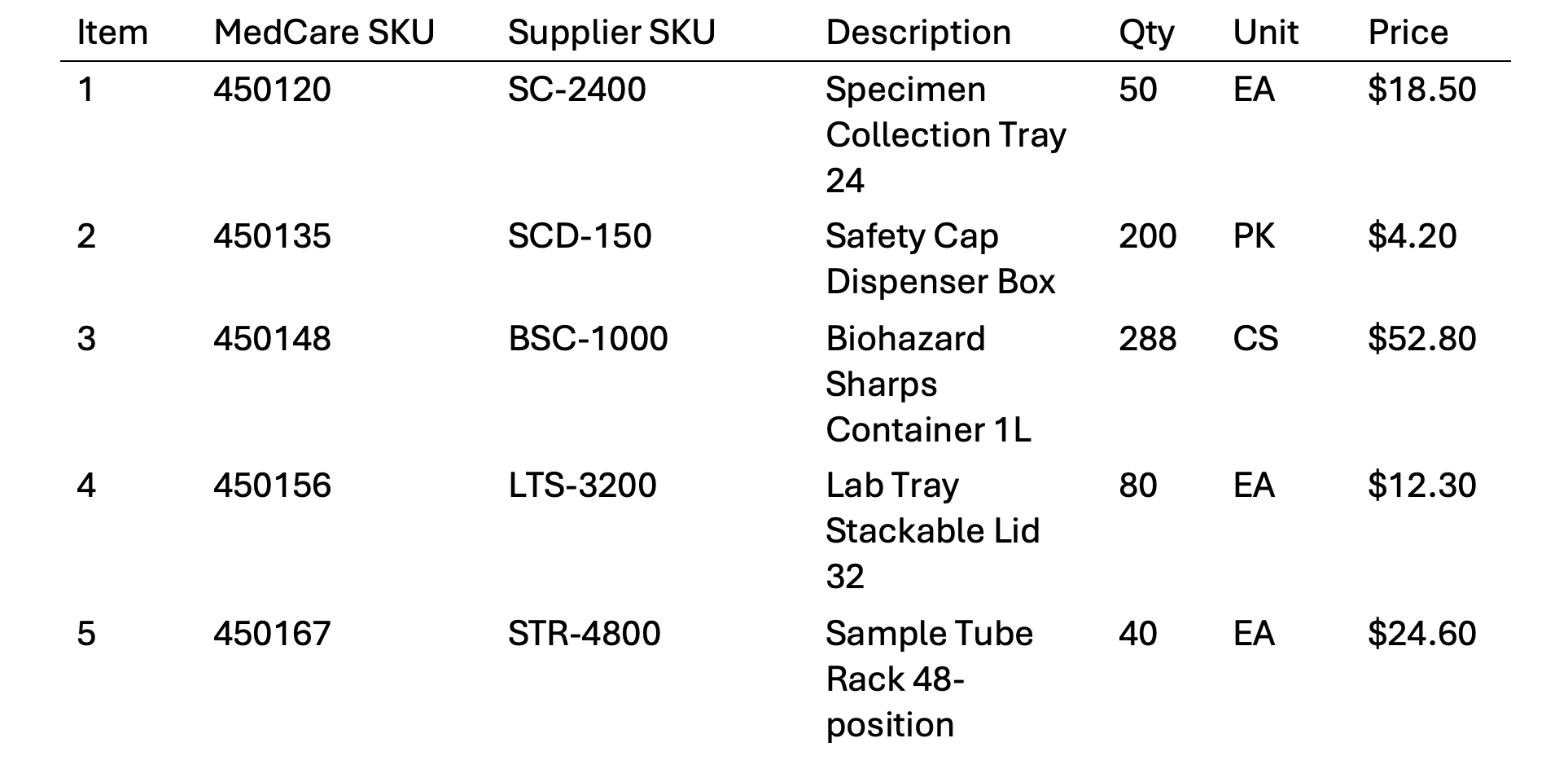
Note the dual SKU system - MedCare’s internal codes alongside the supplier’s part numbers. Payment terms: Net 30 with 2% discount if paid within 10 days.
Pharma Supply confirms the order with their sales order SO-2025-34892. The agent validates:
A critical note appears: “Line 3 (Biohazard Sharps Container)will be dropshipped directly from manufacturer SafeContain Manufacturing Corp.,Houston TX.” This is where things get interesting.
A packing slip arrives fromSafeContain Manufacturing. This document has never seen MedCare’s PO directly.It contains:
For an AP employee, none of these fields line up clearly with what’s in the ERP. A human looking at this document faces several challenges:
The Agent extracts all potential PO number candidates from the document. Each candidate is validated against the known purchase orders database:
When no clear match exists, the Agent can find candidates based on ship-to address, approximate dates, and item descriptions, presenting options for human selection.
The manufacturer’s SKU 42-7156-300 doesn’t appear anywhere in MedCare’s systems. But the Agent has the context:
Using AI fuzzy matching, the Agent compares the packing slip description against the PO line items. “SafeContain Sharps Box 1L” semantically matches “Biohazard Sharps Container 1L” (SKU 450148, supplier code BSC-1000).The mapping is established
The packing slip says 34,560 EA. The PO says 288 CS. Are these consistent?
The Agent consults a unit conversion table that knows, for SKU450148, that 1 case = 120 units.
The math: 34,560 EA ÷ 120 EA/CS = 288 CS ✓
The delivered quantity matches the ordered quantity exactly. This line item is fully delivered.
Pharma Supply sends invoice INV-2025-18294for $16,460.93. Now the three-way match happens.
When an invoice enters the system, it runs through a series of automated checks. Each of the following checks mirrors what AP teams already do manually, but applied consistently and in sequence.
Has this invoice number been processed before?
The Agent queries the invoice history table. A match means immediate rejection, no double payments allowed.
The invoice shows “Pharma Supply America LLC” at “1200 CommerceBoulevard, Chicago, IL 60601”.
The Agent uses AI fuzzy matching against the supplier master data, comparing:
This resolves to Supplier ID 12345, confirming this is a known, approved vendor.
The invoice shows Tax ID 36-4892156. The Agent retrieves the registered VAT numbers for Supplier 12345 from the database and confirms a match. Whitespace and formatting differences are normalized automatically.
The invoice requests payment to Wells Fargo account ending in 7823.The Agent checks this against known bank accounts for Supplier 12345. An unknown bank account triggers a treasury review - a common fraud vector caught automatically.
For each line item on the invoice:
Does the invoiced quantity match what was actually delivered?
The Agent cross-references the processed delivery notes:
PO specifies “Net 30, 2% 10 Net 30”. Invoice shows “2% 10 Net 30”.Consistent ✓
When all checks pass, the system flags it as “approved” and takes action.
This removes handoffs between AP, procurement, and finance that usually slow payment cycles.
Automated outputs include:
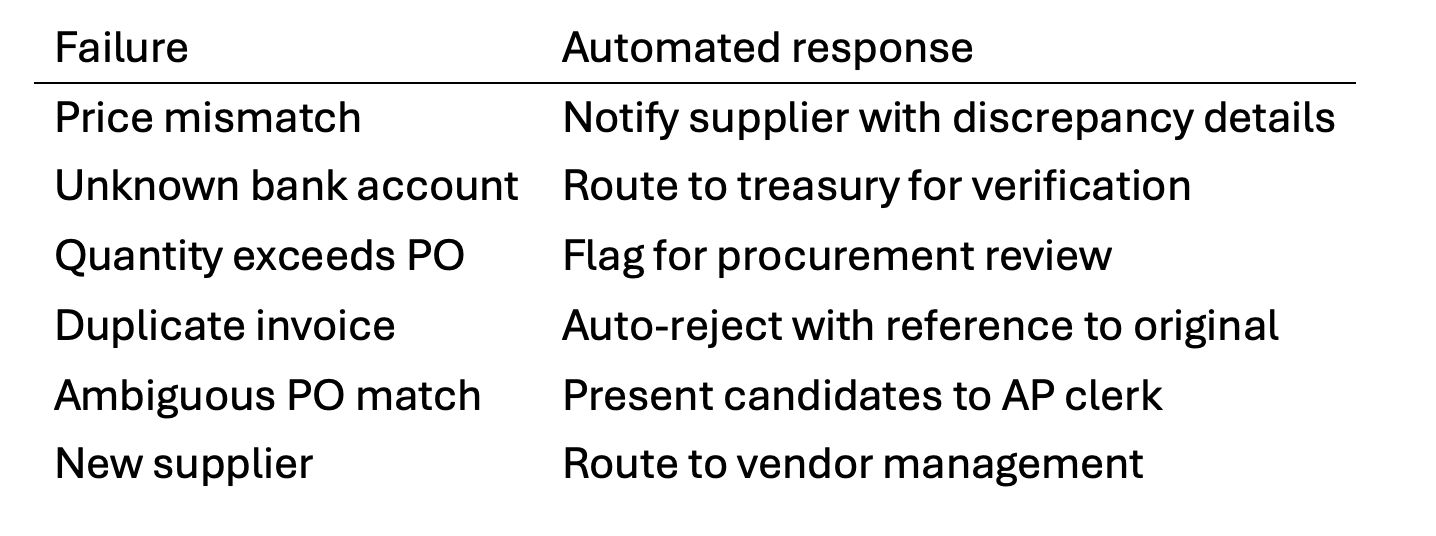
When validation fails, the response depends on the failure type:
Email Monitoring
The Agent watches the AP’s mailbox, automatically detecting and classifying incoming documents. An invoice attachment gets routed to the InvoiceAgent; a packing slip goes to the Delivery Note Agent. No manual upload required.
REST API
For organizations with existing document management systems, documents can be pushed via API with webhook callbacks for processing status.
The lookup tables - suppliers, purchase orders, unit conversions, bank accounts - need to stay current with source systems.
There are two approaches to do that:
Not everything can be automated. AP teams stay in control of exceptions and approvals. The system supports configurable escalation:
Document accuracy depends on the capacity to understanding business information. Each document type has a purpose-built Agent with:
A Packing Slip Agent knows to prioritize handwritten text when looking for PO numbers. An Invoice Agent knows that VAT numbers might have spaces that need normalizing. This domain knowledge is encoded in configuration, not code.
When a lookup fails, the Agent doesn’t stop. Instead, it tries alternatives:
Complex validations are expressed as formulas with access to all extracted data. The duplicate invoice check, for example, iterates through historical invoices looking for a matching invoice number. When found, it returns a failure status with an explanation.
These formulas are configuration, maintained by business analysts, not hardcoded logic requiring developer changes.
The invoice reconciliation workflow described here is just the starting point. The same vertical agent architecture extends to broader supply chain automation:
Price tolerance & Contract compliance
Cumulative tracking for partial deliveries
Tax & Date validations
Credit note handling
Payment optimization
e.g. “Pay $16,131.71by May 2 for 2% discount, otherwise $16,460.93 by May 22”
Accruals management
Supplier performance score-carding
Real-time dashboards
Exception pattern detection
ERP & Accounting systems
Banking & Payments
Communication
Nordoon provides out-of-the-box support for all of these capabilities: custom dashboards for real-time visibility, scheduled agent triggers for periodic processing and reporting, and pre-built integrations with major enterprise systems. The same configuration-driven approach that powers the core extraction and validation extends to these advanced workflows.
For a typical Accounts Payable operation processing dropshipping invoices:
Dropshipping creates a document complexity multiplier. Three parties, three SKU systems, three sets of reference numbers, inconsistent units of measure, partial deliveries, handwritten notes. Traditional approaches like manual processing or simple OCR with rigid templates can’t keep up.
Nordoon’s AI agents solve this with:
The result is zero-day automation: workflows are up and running from day one, no complex setup required. Documents are validated against business rules and actioned automatically, shifting your AP team from document processors to exception handlers.
Subscribe to our newsletter, and we will send AI automation insights like this straight to your inbox on a regular basis.