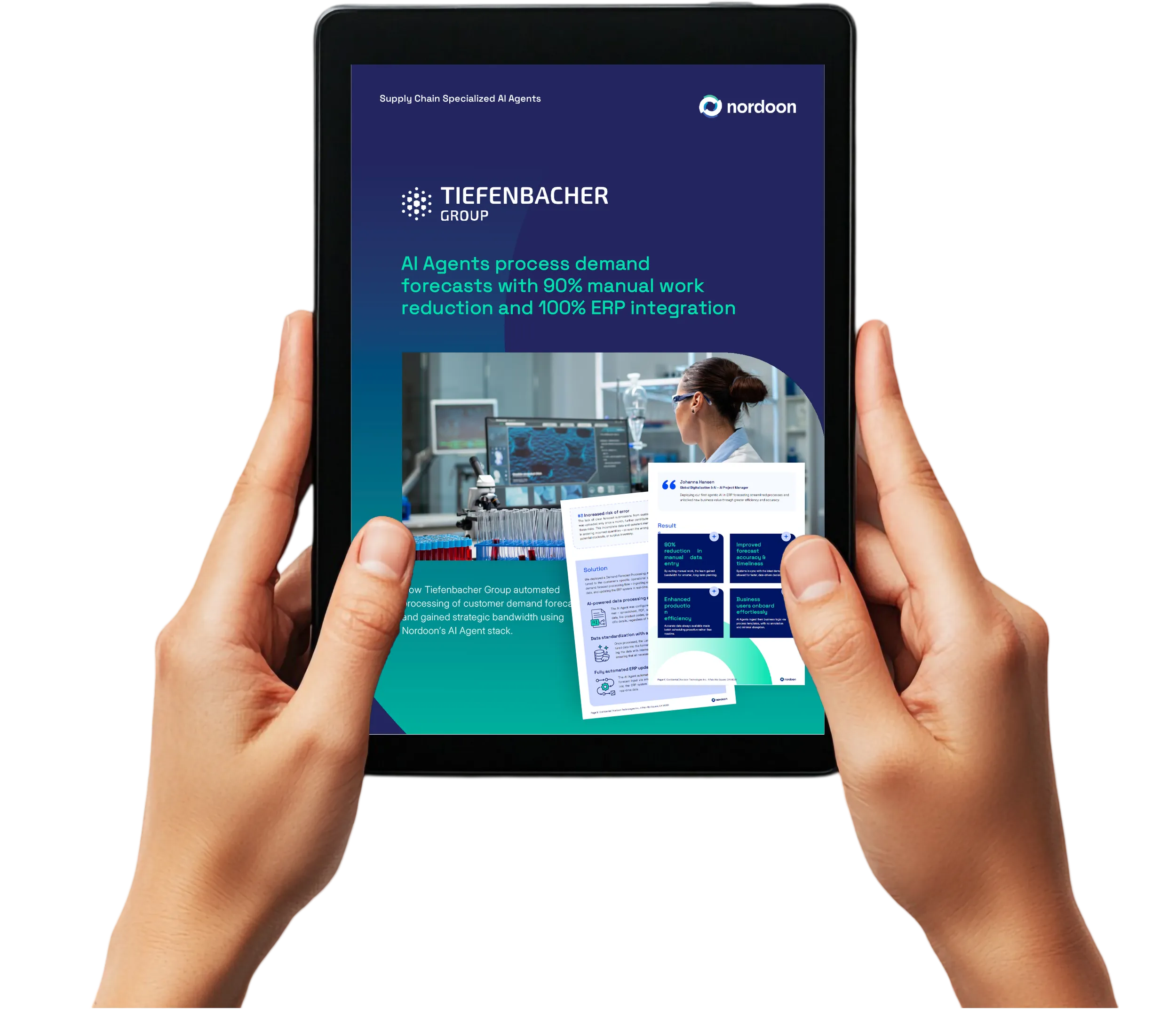
90% less manual work processing pharma demand forecasts

Context
In pharmaceutical manufacturing, accurate demand data is the backbone of planning. When numbers come in late, incomplete, or inconsistent, everything downstream slows: production scheduling, batch allocation, and inventory decisions. That creates unnecessary stock on one side, shortages on the other. Both tie up working capital and risk delays for medications people depend on. Pharma companies need a reliable way to capture demand from day-to-day communication like emails, updates, order changes, without relying on manual entry or individual interpretation.
Challenge
Demand data arrives in many shapes
Many pharma manufacturers still rely on email for demand updates. Customers send forecasts in whatever format works for them: PDFs, spreadsheets, screenshots, long email threads. Templates help, but every customer follows their own workflow, so the formats often drifts. The flexibility is good for relationships smooth, but the data never arrives in a consistent shape, so it can’t go into the ERP as is.
Customer workflows keep changing
Customers update their own ERPs and internal processes, which means the templates you provide may often come back altered. Columns move, structures shift, and old formats stop working. With no stable format, teams spend more time fixing files than using the data.
Heavy manual entry slows everything down
When the incoming data can’t be used directly, employees retype every forecast into the ERP by hand. It’s slow and error-prone. And when updates land in inboxes at different times and in different shapes, procurement ends up working with incomplete or outdated data, losing chances to buy earlier and lower their costs.
Forecasts you can’t rely on
When the source data is inconsistent and manually reworked, planners can’t track changes or link forecasts to actual orders. The final demand plan looks complete but doesn’t reflect real customer needs, leading to overproduction, shortages, and working capital tied up in the wrong places.


Solutions
Nordoon uses AI Agents to capture demand forecasts from any source and turn them into clean, structured data that planning and procurement can trust. The Agents follow the same logic a human planner would, but at scale, and work together to extract, clean, map, and update demand directly into the ERP.
Reading demand data in any format
Agents receive forecasts in whatever format customers send: Excel files, PDFs, scans, photos, or the body of an email. They read the entire message, pick out the right product codes, quantities, dates, and customer details, and turn unstructured inputs into clear data points.
Data cleaning and mapping with LLMs
Using domain-trained LLMs, the Agents clean and structure the data so it fits the ERP’s requirements. They align customer product codes to internal product codes, standardize units and date formats, fill missing fields, and make sure the data is complete and ready for planning.
Automated updates to the ERP
Once the data is structured, the workflow continues automatically. Agents send the validated information straight into the ERP through native integrations. Planning, procurement, and operations stay aligned on the same demand picture, without manual typing, copy-paste or delays.
Change tracking across all customers
Every update is logged. When a customer adjusts quantities, dates, or materials, the Agent spots the difference immediately and tracks it down to each material ID. This gives companies a clear history of how demand evolves. When combined with order-processing Agents, it shows how forecasts compare to actual orders for better customer demand profiling.
See if this fits your operations
Results
More accurate and timely forecasts
AI keeps demand data clean, current, and consistent. This gives planners a reliable view of what customers need and when. Decisions become faster and based on real signals, not manual guesses.
Proactive production planning
With accurate demand available at all times, batch scheduling becomes smoother. Teams plan ahead instead of reacting to outdated or incomplete inputs.
90% less manual data entry
The automated workflow removes repetitive typing and copy-paste work, freeing up teams to focus on strategic planning, procurement timing, and working-capital decisions.
Stronger customer analysis & relations
With less admin to handle, teams spend more time understanding demand patterns, spotting changes early, and building stronger relationships with customers.