Automated warranty workflows for fleet maintenance

Context
For freight and logistics companies, fleet maintenance is one of the biggest cost centers. Trucks and trailers go through constant scheduled and on-the-road repairs, and every intervention adds up. A significant share of these costs could be recovered under warranty, but only if teams manage to identify eligible repairs and file the claims in time. Most companies absorb costs that should have been reimbursed because the tracking, validation, and paperwork are too manual to keep up.
Challenge
Missed warranty checks
When a truck breaks down, the priority is to get it back on the road. Teams rush through emails, portals, and quotes, but the entire process is manual and unstructured. With no reliable way to flag warrantable parts, eligible items get repaired at full cost or discarded without ever being reviewed for recovery.
Hard-to-spot eligible repairs
Finding repairs covered by warranty means digging through supplier portals, repair orders, maintenance logs, invoices, and OEM terms. Too many steps, too many systems – easy for recoverable items to slip through.
Slow coverage verification
Each repair has to be checked against OEM rules: limits, exclusions, timelines. It’s complex, repetitive work, and consistency varies from person to person.
Manual claims every time
Submitting claims to different OEMs requires gathering histories, matching documentation, and preparing evidence by hand. The effort often outweighs the dollar amount, so many claims never get filed.
Without a streamlined workflow, fleets regularly absorb costs that should be recovered, affecting maintenance budgets and overall operational efficiency.

Solutions
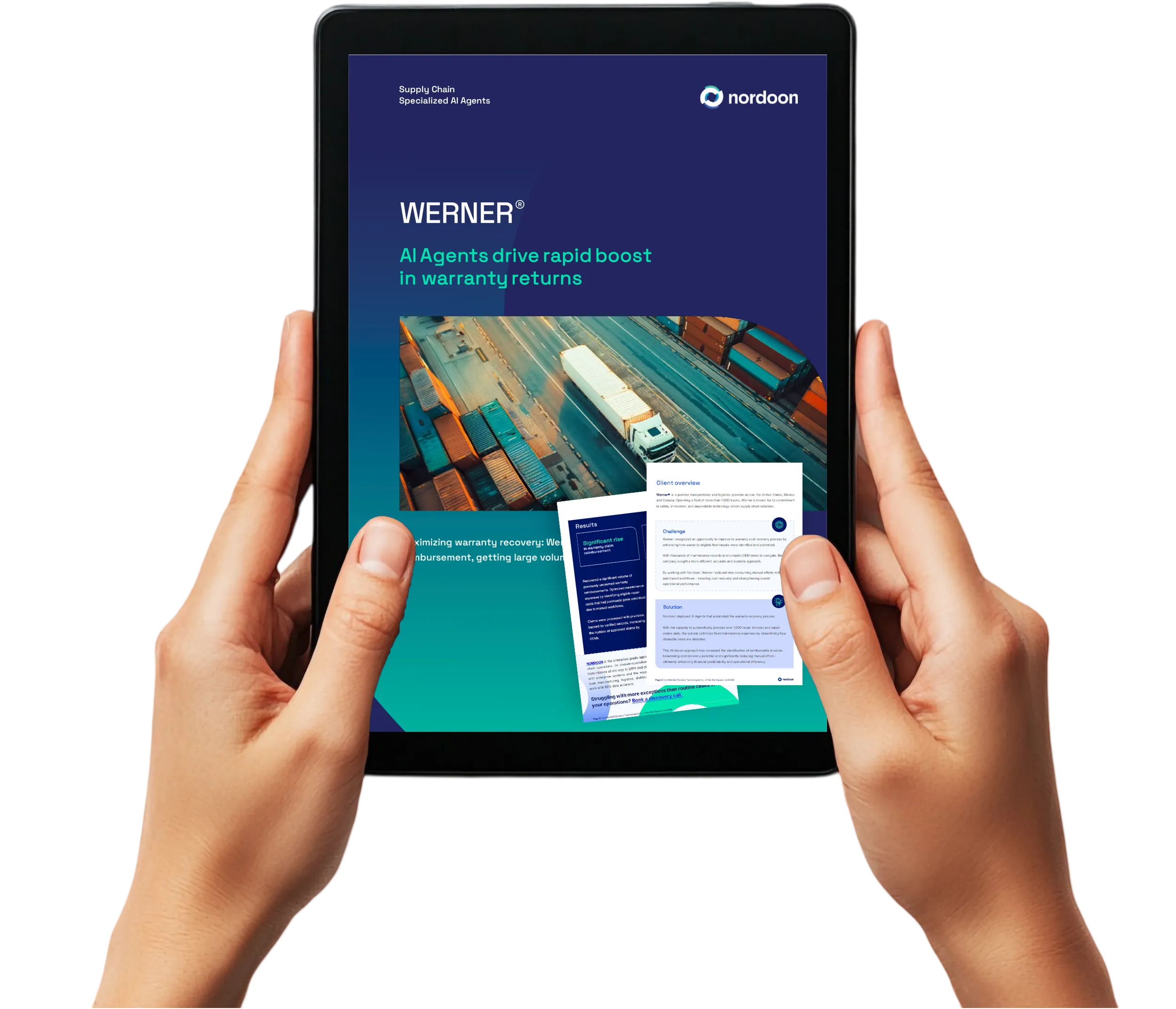
Nordoon runs a Warranty Optimization Workflow driven by specialized AI Agents that help fleets spot eligible repairs early, cut maintenance spend, and recover costs that would otherwise be treated as regular repair spend.
Expert-level repair understanding
AI Agents using domain-trained LLMs read repair orders, invoices, service logs, and notes like an expert. They turn unstructured inputs into clean, structured repair histories and rebuild the full context of each event. With this foundation, they surface cases worth reviewing for warranty recovery.
Automated eligibility checks
Multiple Agents cross-reference dates, mileage, replaced parts, and service details with OEM rules. They flag repairs that qualify for recovery and surface them to the maintenance team for quick reviews. Teams stay in control, but only step in where their judgment is needed.
Keeping teams aligned
The system connects the road-breakdown team, maintenance, and warranty, so potential warranty parts aren’t missed during handoff. Everyone works from the same repair context, reducing back-and-forth. Because Agents have access to all related documents and domain knowledge, accounts payable gets everything it needs to reconcile invoices in one pass; maintenance gets fewer interruptions and fewer errors.
Streamlined claim submission
Once a repair is confirmed as eligible, Agents prepare the claim package: documentation, repair history, supporting evidence. Everything is structured for quick submission to OEM portals. They also turn warranty outcomes and cost-recovery data into structured meta-data for automated ERP updates, giving finance real-time visibility into recovered and unrecovered costs.
Continuous analytics and compliance
Agents review all invoices and service patterns to spot pricing issues and inconsistencies. They surface trends like towing feeds, labor rates, and turnaround times that help identify opportunities for partner agreements or contract renegotiation. They also check supplier invoices against existing contracts to ensure compliance at scale.
See if this fits your operations
Results
Real $$$ reimbursed
Across deployments, fleets have recovered up to seven figures in warranty reimbursements by surfacing eligible repairs that manual processes failed to catch.
1,000 tasks processed per day
AI Agents routinely process on average 1,000 repair tasks per day, removing manual steps and reducing unnecessary vendor follow-up.
Processing time 96% shorter
Warranty claim preparation became up to 96% faster, enabling consistent, automated submissions across multiple OEMs.
Higher claim accuracy
Claims were supported with precision, verified repair data, improving approval rates and reducing repeated reviews.